CONTENTS · OWNER-CREATED WRITING
AI Makes Us More Comfortable — but Who Bears the Risk?
Verification burden, accountability, capability debt, and controlled AI execution.
CORE ARGUMENT
Convenience often transfers risk rather than removing it. Architecture must show who verifies, who approves, and who operates the result.
An opinion article on AI Governance, Human-in-the-loop, and Responsible Agentic AI
Core idea: AI does not make responsibility disappear. It only makes outputs easier to produce, while the burden of verification and the cost of failure remain with people and organizations.
# Comfort Is AI's Most Powerful Feature
AI helps us work faster, analyze more data, and produce work that looks complete in very little time. This is not an advertising claim. It happens every day.
But AI is also a highly effective cognitive convenience machine.
People naturally prefer comfort. When a tool is ready to think, analyze, summarize, decide, and act for us, we gradually transfer the cognitive burden to it without even noticing.
The problem is not that AI is too capable.
The problem is that people are beginning to use AI for work they do not understand well enough, while still believing they can control the outcome.
This is where comfort begins to turn into risk.
# AI Can Produce the Work, but It Cannot Take Responsibility for Us
AI can generate code, design systems, analyze problems, write policies, or propose business plans that appear reasonable even when the user supplies very little information.
Sometimes those outputs genuinely work.
But what the user may not see includes:
- assumptions the AI filled in on its own
- unnecessary complexity
- Security and Privacy vulnerabilities
- Technical Debt that transfers the burden into the future
- Edge Cases that were never mentioned
- real-system constraints absent from the Context
- options that look good in a document but do not fit the organization
AI reduces the cost of producing an answer, but it does not reduce the cost of proving that the answer is correct at the same rate.
When a system fails, data leaks, a budget overruns, or a decision proves wrong, the model is not the accountable party. The user, the team, and the organization that approved the output are.
Put as directly as possible:
AI produces the output, but humans bear the Verification Burden, Failure Cost, and Accountability.
# You Get Something Real — Along with More Than You Realize
Using AI without sufficient domain knowledge is dangerous because users may not recognize what the output added beyond what they actually needed.
Consider an example from Software Engineering:
A user asks AI to add Authentication at one point. The AI may create several extra abstraction layers, change a Dependency, restructure Config, and add mechanisms the team is not prepared to maintain.
The system may compile and the demo may work.
But a user who does not understand the Architecture, Security Boundary, or Operational Constraint will not know what risks the system is accumulating.
The result is therefore not simply “the work was completed faster.” It may be:
A working deliverable accompanied by a long-term burden that nobody knows was created or when it appeared.
# AI Does Not Automatically Find the Root Cause for Us
AI is good at gathering symptoms, connecting information, and proposing causal hypotheses.
But that is not yet the Root Cause.
A Root Cause must be established through evidence from the real system, such as Logs, Traces, Metrics, Reproduction, Experiments, and elimination of hypotheses that do not hold.
AI can quickly say what is “likely to be the cause,” but a person must still prove what the actual cause is.
If users do not understand the system well enough, they may choose the first hypothesis that sounds convincing and rush to implement the fix. The result is:
- treating the symptom instead of the cause
- stacking one Patch on top of another
- introducing new complexity
- destroying the original evidence
- increasing the time needed to find the real cause
The right Prompt should therefore not begin with “fix this.” It should begin with “form hypotheses and define how to prove them first.”
# A Good Prompt Does Not Replace Domain Knowledge
Many people believe the problem is that they are not good at writing Prompts. But a long, detailed Prompt does not guarantee that the instruction itself is correct.
The person giving the instruction must also know:
- which constraints need to be specified
- which important information is still missing
- which methods must not be chosen
- what the Acceptance Criteria are
- how the output must be Validated
- which risks are acceptable
- where human approval is required before action
Without real understanding of the subject, a Prompt may be nothing more than an instruction that sounds good.
AI can still produce an output, but the user will not know what was added unnecessarily, what is missing, or which assumptions should never have been put into production.
# The Four Layers of Risk Organizations Are Taking On
1. Epistemic Risk — Not Knowing Where the Answer Is Wrong
An AI answer may be well structured, use the right terminology, and sound confident. The credibility of its language can be higher than the credibility of its content.
The risk does not arise only when AI is wrong. It arises when people lack the ability to recognize that it is wrong.
2. Execution Risk — Analysis and Action in a Single Instruction
When a Prompt allows AI to analyze, decide, and modify the system immediately, the user loses the checkpoints in between.
Work that should have a Review Gate becomes Autonomous Execution without clear boundaries.
3. Capability Debt — Producing Output Without Building Capability
If people use AI to perform every step for them, they may generate more Output without developing the Mental Models, Pattern Recognition, and judgment that come from solving problems.
This is another kind of debt: Capability Debt.
One day, when AI is unavailable, Context is incomplete, the model is downgraded, or an unfamiliar situation appears, the team may not have enough capability to take over.
4. Compute and Economic Risk — Unit Costs Fall While Usage Grows Faster
The price per Token may continue to fall, but Agentic systems rapidly increase the number of steps, Context, Tool Calls, Retries, Reviews, and Generated Artifacts.
The future bottleneck may therefore be more than the price per Token. It may also include:
- budget per team
- Rate Limits and Capacity
- Latency
- Context Management
- the cost of reviewing Output
- dependence on a Frontier Model
- quality differences when moving to a Small or Local Model
Organizations may need to lower the Model Grade or move some work to a cheaper model. That is appropriate in many situations, but they must accept that reasoning capability and quality may change according to the type of task.
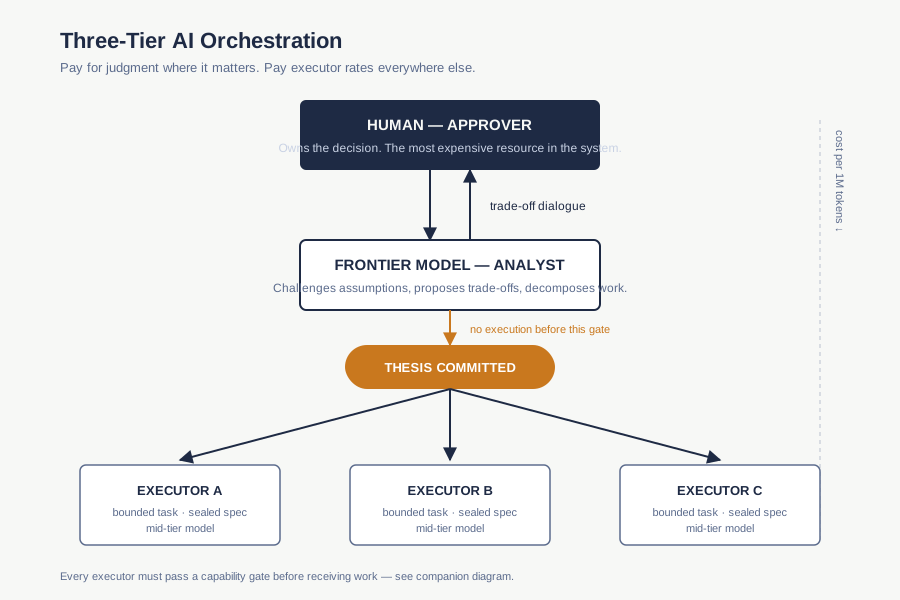
This is not a reason to stop using AI. It is a reason to build Model Routing, Evaluation, and Governance from the beginning.
# Use AI to Strengthen Thinking — Not to Skip It
A safer approach separates the process into four stages:
1. Think First
People define the problem, goals, constraints, initial assumptions, and acceptable outcomes before anything else.
2. Challenge
Use AI to propose alternatives, challenge assumptions, expose blind spots, and explain the reasoning behind what was selected and rejected.
3. Verify
Prove proposals with evidence, tests, and information from the real system. Do not use the fluency of an answer as evidence that it is correct.
4. Execute
Only after passing a Review Gate should execution be allowed, with a limited Scope, sufficient Observability, and the ability to Roll Back.
# Do / Not
Do — Instructions That Preserve Control
- analyze and summarize the approach before acting
- expose assumptions, missing information, and constraints
- explain why an approach was selected and why alternatives were rejected
- propose a way to Validate each conclusion
- separate Analysis, Approval, and Execution
- specify files, systems, or data that must not be modified
- require AI to stop when uncertainty exceeds a defined Threshold
Not — Instructions That Transfer Authority Too Quickly
- “Fix it and proceed.”
- let AI change several systems at once without a Plan
- accept the first answer because its explanation sounds reasonable
- use AI for work that the approver does not understand well enough to Review
- measure success by Output volume instead of quality and impact
- use a Frontier Model for every task without Cost Routing
# Prompt Patterns You Can Use Immediately
Pattern A — Analyze Before Action
Analyze the problem and summarize the approach before taking action. State the assumptions, missing information, impact, risks, and verification method. Do not edit files or change the system until approval is given.
Pattern B — Decision Trace
Present the viable options. Explain why each approach was selected or rejected, including its Trade-offs, Failure Modes, and the conditions under which the decision should change.
Pattern C — Root Cause Discipline
Separate symptoms from the Root Cause. Form multiple hypotheses, identify the evidence that supports or disproves each one, and propose the lowest-cost validation step first. Do not modify the system based on a hypothesis that has not been verified.
Pattern D — Controlled Execution
After approval, act only within the defined Scope. List the files or resources that will change before making modifications, retain the necessary Observability, and prepare a Rollback Plan. Do not expand Scope automatically.
# The Counterargument We Must Accept Honestly
This article does not claim that AI automatically makes people think less.
On the other hand, AI can help people learn faster, allow beginners to see how experts think, raise questions users would never have considered, and reduce time wasted on repetitive work.
Someone who uses AI as a Sparring Partner may develop faster than someone who refuses to use AI at all.
The important variable is therefore not merely whether someone “uses AI.” It is:
- at which stage of the process AI is used
- whether users must still explain their own reasoning
- whether a Feedback Loop exists
- whether verifiable evidence exists
- whether the organization rewards speed alone or also rewards decision quality
AI is a double-edged sword not because the technology has malicious intent, but because it satisfies the human desire for comfort too well.
# Conclusion
The important question in the AI era is not merely:
How much work can we make AI do for us?
We should instead ask:
Do we understand the work well enough to know whether AI is leading us in the right direction, or merely moving us faster along the wrong path?
Good AI should not remove the human responsibility to think.
It should help people think more broadly, see risks earlier, and make decisions using better evidence.
The organization that gains the advantage may therefore not be the one that lets AI do the most work, but the one that knows which work AI should accelerate, which work humans must decide, and which checkpoints must never be bypassed.
EVIDENCE NOTE
Claim boundary
This page renders the original article source from Information while preserving its reasoning and limitations. It does not claim every pattern is used in production and does not invent metrics beyond the source.